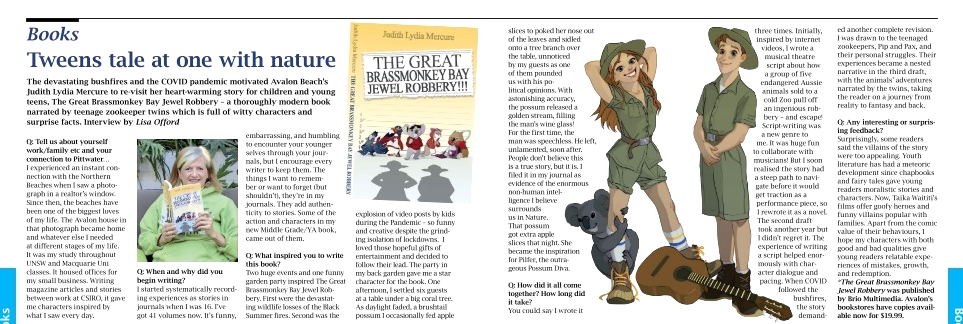
Pittwater Life Editor Lisa Offord asked Judith Lydia Mercure about what motivated her to write books for young audiences during what seems to many to be a period of relentless crisis (originally published in Pittwater Life, September 2021, pp 50-51). Local (Avalon Beach) bookstores Bookoccino and Beachside Books stock Judith Lydia’s latest book, The Great Brassmonkey Bay Jewel Robbery for A$19.99.
Lisa: Tell us about yourself work/family etc and your connection to the Northern beaches.
Judith Lydia: I experienced an instant connection with the Northern Beaches when I saw a photograph in a realtor’s window. Since then, the beaches have been one of the biggest loves of my life. That Avalon house in the photograph became home and whatever else I needed at different stages of my life. It was my study after UNSW and Macquarie Uni classes. It housed offices for my small business. Writing magazine articles and stories between work at CSIRO, it gave me characters inspired by what I saw every day.
Lisa: When and why did you begin writing?
Judith Lydia: I started systematically recording experiences as stories in journals when I was sixteen. I’ve got 41 volumes now. It’s funny, embarrassing, and humbling to encounter your younger selves through your journals, but I encourage every writer to keep them. The things I want to remember or want to forget (but shouldn’t), they’re in my journals. They add authenticity to stories. Some of the action and characters in my new Middle Grade/YA book, can be found in them.
Lisa: What inspired you to write this book?
Judith Lydia: Two huge events and one funny Garden Party inspired The Great Brassmonkey Bay Jewel Robbery. First were the devastating wildlife losses of the Black Summer fires. Second was the explosion of video posts by kids during the Pandemic—so funny and creative despite the grinding isolation of lockdowns. I loved those hopeful gifts of entertainment and decided to follow their lead.
The party in my back garden gave me a star character for the book. One afternoon, I settled six guests at a table under a big coral tree. As daylight faded, a brushtail possum I occasionally fed apple slices to poked her nose out of the leaves and sidled onto a tree branch over the table, unnoticed by my guests as one of them pounded us with his political opinions.
With astonishing accuracy, the possum released a golden stream, filling the man’s wine glass! For the first time, the man was speechless. He left, unlamented, soon after. People don’t believe this is a true story, but it is. I filed it in my journal as evidence of the enormous non-human intelligence I believe surrounds us in Nature. That possum got extra apple slices that night. She became the inspiration for Pilfer, my outrageous Possum Diva.
Lisa: How did it all come together? How long did it take?
Judith Lydia: You could say I wrote it three times. Initially, inspired by internet videos, I wrote a musical theatre script about how a group of five endangered Aussie animals sold to a cold Zoo pull off an ingenious robbery—and escape!
Script-writing was a new genre to me. It was huge fun to collaborate with musicians. But I soon realised the story had a steep path to navigate before it would get traction as a performance piece, so I rewrote it as a novel. The second draft took another year but I didn’t regret it. The experience of writing a script helped enormously with character dialogue and pacing.
When COVID followed the bushfires, the story demanded another complete revision. I was drawn to the teenaged Zookeepers, Pip and Pax, and their personal struggles. Their experiences became a nested narrative in the third draft, with the animals’ adventures narrated by the twins, taking the reader on a journey from reality to fantasy and back.
Lisa: Any interesting or surprising feedback from readers you’d like to share with us?
Judith Lydia: Surprisingly, some readers said the villains of the story were too appealing. Youth literature has had a meteoric development since chapbooks and fairy tales gave young readers moralistic stories and characters. Now, Taika Waititi’s films offer goofy heroes and funny villains popular with families. Apart from the comic value of their behaviours, I hope my characters that have both good and bad qualities give young readers relatable experiences of remorse, change, and redemption.
 The Artful Gluffster