Just about everybody these days, judging from the proliferation of talent shows and emerging superstars on TV and social media.
But is there a downside? Chilli Koala, Leader of the Magic Island Gang, thinks there are plenty! Is it seductive? You bet!
He was a shy poet before gaining unwanted celebrity at Brassmonkey Bay Zoo. But Chilli and the Zoo’s keepers fell under the spell of spotlights and applause. In fact, Chilli was so concerned, he wrote a song about it (with the help of musician/songwriter Jon Ross) that gives us an insight into how the mastermind of THE GREAT BRASSMONKEY BAY ZOO ROBBERY feels about fame!
Or order a copy of The Great Brassmonkey Bay Jewel Robbery. It’s perfect for middle-grade readers and a musical script of the story is available to community and youth theatre groups!
Most scholarly studies will tell you that criminal offenders are predominately male and victims mostly female. Statistics from most countries support this pattern. For example, while males comprise 89.5% of offenders found guilty of homicide in the United States, females comprise 63.7% of victims of domestic homicide and 81.7% of sex-related homicide.
But gender bias doesn’t apply equally to all crimes. Women and girls seem nearly as prone to commit non-violent crimes for significant material gain as men and boys. Financial crimes are particularly democratic, according to 2011 FBI arrest data. Males constitute 58.7% of fraud arrests, 57.3% of larceny-theft, and only 51.3% of embezzlement arrests, making it clear that women make up nearly half of this category of criminal.
As storytellers often need female villains in their narratives, we need to know what motivates females to commit crimes and how they may go about it. There are many reasons, but inequity has been a major motivator. Throughout history, fewer economic and vocational opportunities have driven women to steal, commit procurement and prostitution offenses, forgery and embezzlement, and so on, to survive. In this post we turn to the history of a fascinating subset of women criminals to continue our exploration of literary villains.
Although far fewer than theft crimes, not all crimes committed by women are non-violent. Histories of female criminals in Europe include surprisingly large numbers of women who impersonated males to commit many different types of crimes. Girls from impoverished backgrounds knew they had few opportunities to support themselves apart from marriage, domestic service or prostitution, boys had more (often dangerous) advantages: they could join criminal gangs or the military. Some females copied their example.
Gender-neutral attire was rare among Europeans until the 20th century. Despite this, significant numbers of women passed as men, especially in northern Europe in the 17th to the 19th century when frequent wars called for fighters and offered heavier clothing that disguised gender differences.
Encouraged by successful temporary cross-dressing experiences like carnival costumes, erotic or stage performances, some women disguised themselves as men to earn a living at war, at sea, or on the streets as cutpurses. But they soon discovered that the successful impersonation of a male for longer periods of time was difficult. The lack of privacy in the lives of the destitute posed special challenges. Throughout much of human history, poorer classes ate, slept, dressed, relieved themselves, and sometimes fornicated in company. How women overcame these obstacles offers fascinating lessons in resourcefulness and determination too extensive to be treated here.
There are histories of the subject. I have been interested in early cross-dressing women since I translated a book from Dutch into English by Rudolf Dekker and Lotte van de Pol, The Tradition of Female Transvestism in Early Modern Europe (Macmillan, London, 1989). This study was among the first to catalogue the histories of women living as soldiers, sailors, (male) robbers or pickpockets primarily in the Netherlands, Germany and England in the early modern period.
The 119 cases investigated by the authors were based on Dutch judicial archives and early popular songs. Some of these sources revealed women who dressed as men in order to join bands of violent street thieves and criminals. For example, Anna Hillighering in 1724 Leiden spent most of her lives as a man. Isabella Geelvinck lived as a man for 15 years before being convicted of theft and arson in Utrecht in 1673. Trijn Jurriaens was found guilty of enlistment fraud, forgery, and being an imposter. She was discovered to be a woman only when she was stripped and whipped for her crimes in 1747. Some women dressed as men to marry women they loved. At the time, this was also a crime. Some lived undiscovered for years, occasionally even by their spouses! Once discovered, however, the responses of both peers and authorities were rarely favorable.
Unless they were exonerated by military success or they returned meekly to a feminine life, these women were often abused, rejected and punished, including by imprisonment, exile, whipping and fines. Their crime was upsetting the ‘natural order of life’.
These women baffled and appalled their contemporaries. For example, after a successful military career, one eminent soldier, Aal the Dragoon, was killed around 1710 in a fight over a card game. So astonished were fierce Aal’s former colleagues to discover that their compatriot was a woman that she was stuffed, placed sword-in-hand on the carcass of a horse, and displayed for nearly a century in a Rotterdam anatomy theatre. Surrounding her were malformed babies and animals preserved in alcohol considered as freaks and unnatural phenomena by scientists and surgeons of the time (Dekker and van de Pol, 1987, p 73).
Although educated elite folks were often more tolerant, being aware of positive literary examples like Joan of Arc, the common people among whom these women lived possessed education and experience too limited to understand these women. Yet despite the rejection and abuse they faced from family and peers, the women persisted.
Writers can never know what memories and experiences will inspire them creatively. This early project gave me the inspiration for one of my youth fiction characters. He dressed as a cleaning woman for his role in The Great Brassmonkey Bay Jewel Robbery. His objective, like most of the women in these stories, was to be free to live life as he wished. Stories of undaunted persistence show readers how women who were considered historical villains have been elevated by literature to become modern heroes, leading the battle against intolerance.
Psychologist Bruno Bettelheim wrote in his 1977 classic, TheUses of Enchantment, that fairy tales and other fantasy stories provide a safe stage where young people can rehearse life’s big events, playing out their dreams and nightmares. Story-tale heroes are like avatars kids can use or discard without consequences. But what about villains? What is it that makes a villain so irresistible to kids? What do we mean by a ‘good’ villain?
Sammy Snatch is one of the Magic Island Gang’s three irresistible villains (c) Brio Multimedia 2020.
What role do villains play for us? What kid–or adult, for that matter–can resist a good villain in a book, film or theatre performance? How bland would our stories be without the foreboding and danger provided by a good villain?
A ‘good villain’ is definitely not a good person. Young readers need to see heroes overcome villains. Good must triumph over evil if life is not to be unbearably frightening. And a hero without a villain has no challenge.
The element of surprise in any story is exciting, and a good story-teller’s villain should be unpredictable. We should not know what he or she will do next. As kids know better than anyone, no one can be good all the time.
Villains give kids someone to relate to when they have been cruel, told lies, or hurt others. Villains give us models for our dark moments. A good villain sometimes has a tragic backstory that explains–and to a degree, excuses–their villainy. Without villains, it is hard to learn what it is to feel remorse, and to grow from it.
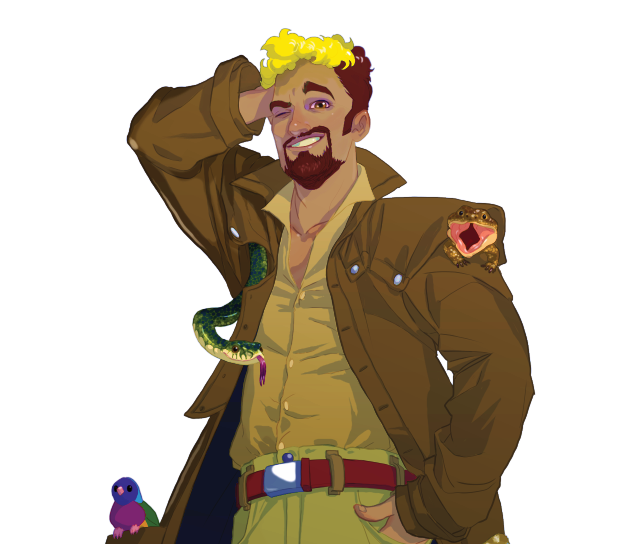
The Great Brassmonkey Bay Jewel Robbery introduces three villains to the Magic Island Gang series. The first we meet is Sammy Snatch, a heartless smuggler of endangered animals. Clad in a long coat with pockets that are stuffed with his tiny prey, how can Sammy be anything but despicable? He’s a rough fellow. When Sammy gloats over his successes, we imagine him at home after a long day of trapping and poaching, sitting in his chair with a groan, and bending over, we think, to pull off his muddy boots.
Until he pulls off his wooden leg and tips out a little marsupial mouse!
Immediately, we are taken aback. The unshaven Sammy is admittedly a good-looking rogue. His wooden leg adds mystery, the possibility of tragedy, and even a touch of rock-star glamour to the fellow. What is Sammy’s back story, we cannot help but wonder?
Time after time, in the story, Sammy commits unconscionable crimes. But despite this, we never quite turn our backs on him.
Instead, we forgive him when he traps and sells endangered animals to the story’s second villain, the greedy Zoo Director Caspar Hustle. We forgive him when he can’t help but flirt with the third villain, Scarlet Swindle.
We forgive Sammy when he hangs around Brassmonkey Bay, living off his ill-gotten gains, too lazy to do his job.
When he cons Director Hustle by selling Pilfer Possum as an endangered animal, we forgive him again.
We even forgive him when he tracks down the Gang, aiding and abetting a plot to bring them down.
Why?
Sammy is quirky. Dangerous. But he is also funny. Sammy is handsome enough to be the boyfriend even good girls wish they had had, if only for a short spell. In fact, Sammy is such an appealing villain, there are times in the book when he threatens to hijack our sympathy! At the end of The Great Brassmonkey Bay Jewel Robbery, Sammy gets a serious ‘time out’ to think about his crimes.
Does it work?
Either he has to redeem himself sufficiently to merit our readers’ sympathy or he has to continue to behave so appallingly, readers will stop forgiving him for his charm and good looks and attend to their own job of looking after the greater good of Sammy’s endangered victims.
Read The Great Brassmonkey Bay Jewel Robbery to find out.
Do you agree that Sammy is no exception to Bettelheim’s theory? That he offers us lessons in moral dilemmas, a caution against falling in love with the wrong guy, against making self-serving mistakes, against being tempted to make choices we regret?
Listen to Sammy’s signature song, ‘Smugglers’ Jig’ above for clues.
Then watch out for the ‘Artful Gluffster’ post about another Brassmonkey Bay villain–Scarlet Swindle. What does she have in common with Sammy Snatch? And what do Scarlet and Sammy teach us about what makes a really satisfying villain?
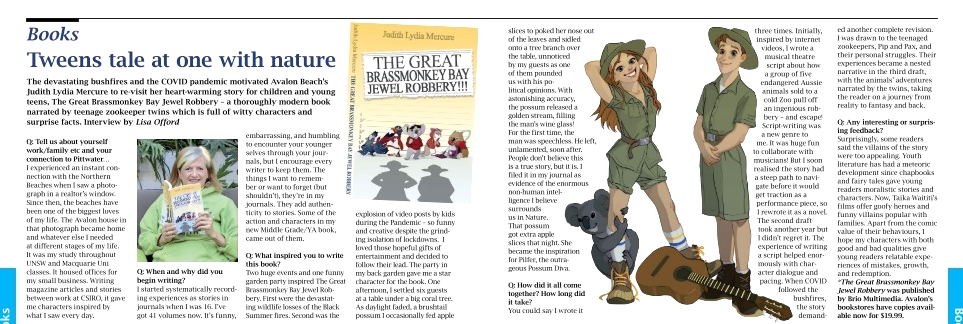
Pittwater Life Editor Lisa Offord asked Judith Lydia Mercure about what motivated her to write books for young audiences during what seems to many to be a period of relentless crisis (originally published in Pittwater Life, September 2021, pp 50-51). Local (Avalon Beach) bookstores Bookoccino and Beachside Books stock Judith Lydia’s latest book, The Great Brassmonkey Bay Jewel Robbery for A$19.99.
Lisa:Tell us about yourself work/family etc and your connection to the Northern beaches.
Judith Lydia:I experienced an instant connection with the Northern Beaches when I saw a photograph in a realtor’s window. Since then, the beaches have been one of the biggest loves of my life. That Avalon house in the photograph became home and whatever else I needed at different stages of my life. It was my study after UNSW and Macquarie Uni classes. It housed offices for my small business. Writing magazine articles and stories between work at CSIRO, it gave me characters inspired by what I saw every day.
Lisa: When and why did you begin writing?
Judith Lydia:I started systematically recording experiences as stories in journals when I was sixteen. I’ve got 41 volumes now. It’s funny, embarrassing, and humbling to encounter your younger selves through your journals, but I encourage every writer to keep them. The things I want to remember or want to forget (but shouldn’t), they’re in my journals. They add authenticity to stories. Some of the action and characters in my new Middle Grade/YA book, can be found in them.
Lisa: What inspired you to write this book?
Judith Lydia:Two huge events and one funny Garden Party inspired The Great Brassmonkey Bay Jewel Robbery. First were the devastating wildlife losses of the Black Summer fires. Second was the explosion of video posts by kids during the Pandemic—so funny and creative despite the grinding isolation of lockdowns. I loved those hopeful gifts of entertainment and decided to follow their lead.
The party in my back garden gave me a star character for the book. One afternoon, I settled six guests at a table under a big coral tree. As daylight faded, a brushtail possum I occasionally fed apple slices to poked her nose out of the leaves and sidled onto a tree branch over the table, unnoticed by my guests as one of them pounded us with his political opinions.
With astonishing accuracy, the possum released a golden stream, filling the man’s wine glass! For the first time, the man was speechless. He left, unlamented, soon after. People don’t believe this is a true story, but it is. I filed it in my journal as evidence of the enormous non-human intelligence I believe surrounds us in Nature. That possum got extra apple slices that night. She became the inspiration for Pilfer, my outrageous Possum Diva.
Lisa: How did it all come together? How long did it take?
Judith Lydia:You could say I wrote it three times.Initially, inspired by internet videos, I wrote a musical theatre script about how a group of five endangered Aussie animals sold to a cold Zoo pull off an ingenious robbery—and escape!
Script-writing was a new genre to me. It was huge fun to collaborate with musicians. But I soon realised the story had a steep path to navigate before it would get traction as a performance piece, so I rewrote it as a novel. The second draft took another year but I didn’t regret it. The experience of writing a script helped enormously with character dialogue and pacing.
When COVID followed the bushfires, the story demanded another complete revision. I was drawn to the teenaged Zookeepers, Pip and Pax, and their personal struggles. Their experiences became a nested narrative in the third draft, with the animals’ adventures narrated by the twins, taking the reader on a journey from reality to fantasy and back.
Lisa: Any interesting or surprising feedback from readers you’d like to share with us?
Judith Lydia:Surprisingly, some readers said the villains of the story were too appealing. Youth literature has had a meteoric development since chapbooks and fairy tales gave young readers moralistic stories and characters. Now, Taika Waititi’s films offer goofy heroes and funny villains popular with families. Apart from the comic value of their behaviours, I hope my characters that have both good and bad qualities give young readers relatable experiences of remorse, change, and redemption.
Literary villains, with their unpredictable actions, raise the stakes in most stories, creating surprise and excitement for audiences. Villains give heroes (and many authors) reason to live, giving them something or someone to overcome in the universal battle between good and evil. Villains provide a dark mirror of our weaker selves when we err or fall into temptation. As sources of temptation in cultures where deferred gratification is still a thing, villains are sexy.
The Artful Gluffster has reflected on male villains in literature in a recent post. In this post, let’s talk about female villains.
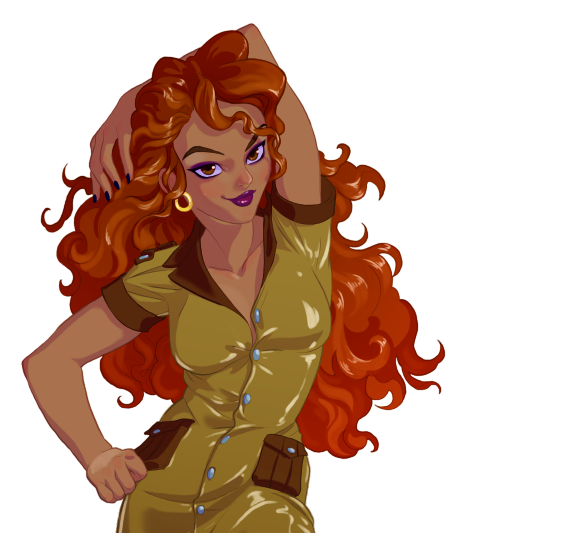
Scarlet Swindle may share her dangerous powers with goddesses and huntresses, but she is a thoroughly modern female villain.
Female villains share some of the sex appeal of their brothers, but they are rarer and have a history of being objects of ambivalence.
There are three popular sources of inspiration for female literary villains commonly used by writers:
(1) archetypes, (2) real female criminals, and (3) females who disguised themselves as males to pull off crimes.
Let’s start with archetypes, those universally understood symbols and prototypes that reappear in myths and legends across different cultures. Evil females have been a source of fascination since humankind first began to repackage fear, surprise, hostility and awe into recurrent archetypes our ancestors could comprehend and, they hoped, manage.
Throughout history, women who have not been submissive have been characterized as evil, while meek and obedient females were considered good. When their defiant ability to disquiet fathers, husbands and brothers couldn’t be managed by mere domination, non-submissive female archetypes were attributed superpowers–and dangerous.
Some scholars believe such archetypes were cultural inventions born of fear and hostility toward women, possibly linked to the mysteries of an unpredictable nature like childbirth.
Jungian psychologists categorize archetypes of women as mothers, queens, huntresses, wise women, mystics and lovers. However many other taxonomies exist. In our search for early female villains, we will look at archetypes of women and girls as powerful members of the ‘Dangerous Sex’. We probably can’t do better than Ishtar, Kali, Hecate, and Lilith. Here’s why.
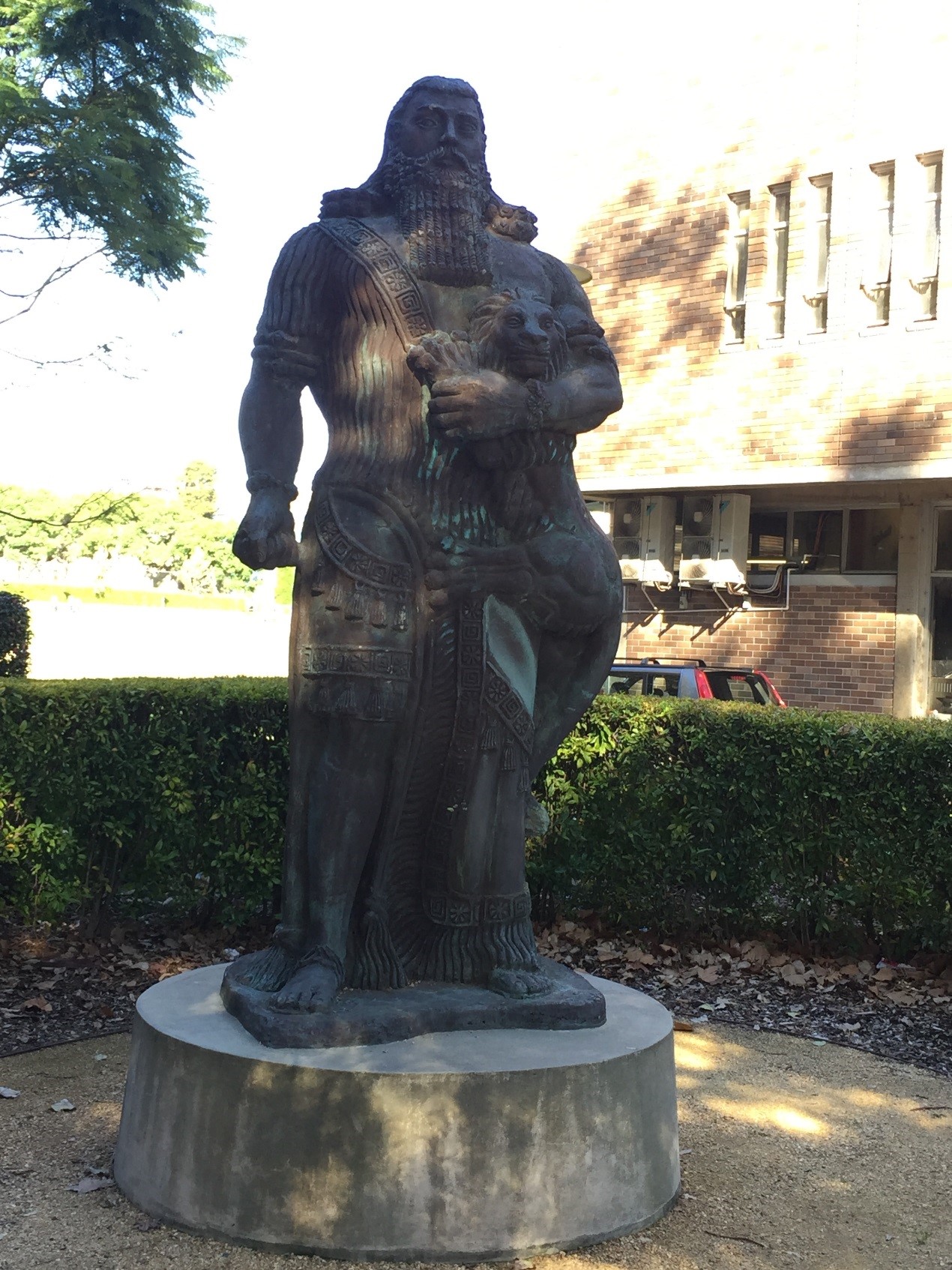
The Statue of Gilgamesh at the University of Sydney, Camperdown, was created by Lewis Batros on commission from the Assyrian community, and unveiled in 2000. Photo by Yalenalovely.
Mythologies of many cultures include goddesses and witches. Supernatural archetypes are usually viewed as capable of both good and evil. This duality probably reflects a perception of women in many cultures that is both positive and negative, as sources of life and as maternal guardians and guides. It also suggests awareness of the corrupting temptations of wealth, power and sex, and the unpredictability of nature. Goddesses are often associated with both the ‘tomb and the womb’, as the source of life and a guide on the path that ends in mortality. Pretty serious subjects, no?
There are too many examples to list here, so we will focus on a few powerful female archetypes who have been particularly popular, popping up in stories and artworks like mushrooms after a rain. Such characters have been with us for a long time, populating oral tradition and filling clay tablets with great stories and dialogue. One of the earliest sources of female archetypes was the Babylonian collection of epic poetry, The Epic of Gilgamesh.
This collection of poems, dating from around 1000 BCE, is a rich source of female archetypes, giving us not only the warrior goddess Ishtar, but also maternal and spiritual guides in the form of the priestess and temple prostitute, Shamhat, and the tavern-keeper, Shiduri.
Gilgamesh gives us a fine female literary villain in the creator-destroyer goddess, Ishtar. Her attempts to seduce King Gilgamesh simmer deliciously through dialogue like the following: “Marry me, give me your luscious fruits, / be my husband, be my sweet man. / I will give you abundance beyond your dreams.”
For those unfamiliar with the complicated and racy plot, Gilgamesh is tempted by Ishtar’s offer, but eventually demurs on the grounds that it might be fun at first but, given the trail of corpses that were once Ishtar’s husbands, could get unpleasant later. Ishtar takes pride of place as story-tellers’ first recorded temptress goddess.
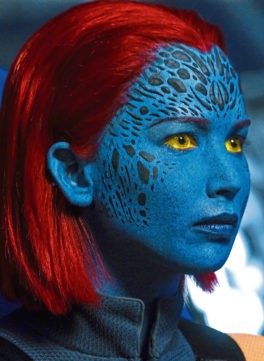
Jennifer Lawrence played Mystique in several X-men films from 2011-2019 (c) 20TH CENTURY FOX
There are many other female archetypes we might consider, but let’s look at a few who have been notably popular in literary works and films. For example, Kali is one of the most dire of Hindu goddesses. Her blue skin and necklace of skulls could be the stuff of kids’ nighttime terrors. Her duality is evident when she hunts down and kills demons to protect the innocent. Kali can also rampage out of control, with lethal impact. She was associated with the inevitability of human morality. Her name was translated as “the fullness of time” and “the changing aspect of nature that brings things to life or death” . She was created by a patriarchal culture that viewed ideal women as submissive but was in fearful awe of the unpredictable inevitability of death.
Bloodthirsty, uncontrollable, and female, Kali represented nature at its most untamed and fearsome. For story-tellers of the present as well as the past, Kali was pretty irresistible stuff. Her stuck-out blood-red tongue became a pop icon when it inspired the logo on a 1970 Rolling Stones album. An evil cult of Kali-worshippers also appeared in “Indiana Jones and the Temple of Doom”. Kali may well have inspired the creation of Mystique in X-Men films from 2011-2019
How do archetypes feature in modern family entertainment? Do modern youth audiences view these characters the same way as the (admittedly not numerous) readers of Gilgamesh probably did? The challenges archetypes face are timeless. Indeed, timelessness defines archetypes and their challenges. But have archetypes evolved?
Scarlet Swindle in The Great Brassmonkey Bay Jewel Robbery, for example, is easily the most ruthless of the book series’ three villains, Scarlet, Sammy Snatch, and Caspar Hustle. Scarlet shares her ruthlessness (by exploiting vulnerable animals) and her seductiveness (in erotically manipulating both Sammy and Caspar) with female archetypes like Lilith and Ishtar. A future post will talk about Scarlet in more detail.
In Brassmonkey Bay, however, all the villains are also caricatures, as their names suggest. This exposes their behaviors and attitudes to humor for younger readers and ridicule for older ones. As a series written for family entertainment, the Magic Island Gang books are intended to be relevant to readers of different ages. With even very young audiences becoming increasingly sophisticated, comic and film superheroes of today have very often become comedians–as the characters, male and female, in ‘Deadpool’, ‘Aquaman’, ‘Ironman’, ‘Thor’, and many other comics and films demonstrate.
Check back for more Artful Gluffster posts on what makes literary villains modern.
How do authors create engaging characters? Let’s take the animal characters in The Great Brassmonkey Bay Jewel Robbery. What shaped those characters? Like most writers, when I created Pilfer Possum, her personality was based to a significant degree on some real possums who live in my garden, my trees, and sometimes, my garage.
Called by some readers an ‘out-of-control Diva’, Pilfer Possum is a relentless source of antics in the book. Two of her adventures inspired the teaser song at the bottom of this article. But were they invented? Not entirely. I got quite a bit of inspiration. Let me give you two examples.
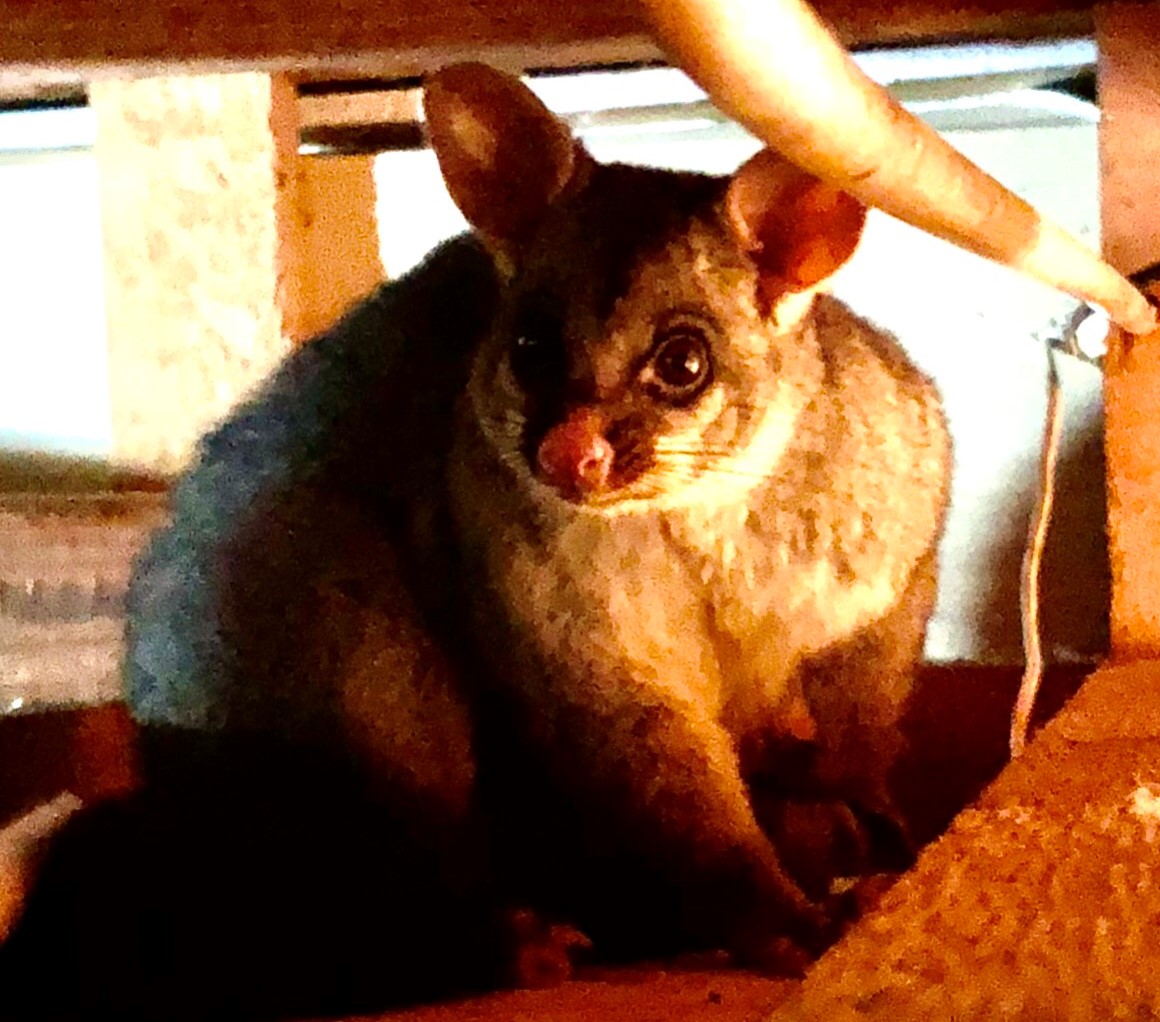
Some people think Australian Brush-tailed Possums are nuisances, but they are also irresistible. Their scientific name Trichosurus vulpecula means ‘furry tailed’ and ‘little fox’. They have big, intent eyes, and improbably pink noses. Like many critters, they have become increasingly confident in their interactions with humans. They are adaptable, but also territorial. Unlike their attitudes to cats and dogs, Brush-tails get used to people coming and going onto what they clearly believe is their turf. When you have been sound asleep and they run across the roof over your head in the middle of the night, you can’t ignore them: because it sounds like they are wearing Army boots.
One night I heard something more than the usual thrashing about on my metal roof: a resounding thump that sounded like it was coming from my living room. I blundered sleepily out of my bedroom and switched on the light. To my astonishment, an adult possum was sitting on the top of my bathroom door. We stared at each other. It took some time to consider my options, as I didn’t fancy her using me as a scaling ladder or my chasing her through the house if I scared her down from her precarious perch. Eventually I fetched a chair and a towel. She braced herself for a scramble down my back to the floor but was successfully wrapped up (which, fortunately, makes them go quiet) and released into the garden. She bolted into the darkness.
But how on earth did she get into the living room, I wondered. There were no open doors or windows. I abandoned the mystery and went back to bed. The next morning, I looked around. I finally stopped in front of my gas fireplace. It has a glass front and sides. On the inside, which I rarely cleared of dust and soot, I noticed two sets of parallel ribbon-like streaks.
The clues were irrefutable: the possum must have crept from the roof into the chimney, looking for shelter. She had slipped, making a desperate effort to cling to the interior of the chimney as she fell. The streaks were made by the soft pads on her paws as she made a futile effort to grip the smooth surface of the glass. Why she chose to claw her way up a wooden bathroom door and perch on the top, I’ll never know. I suspect the door may have been the first object she encountered that promised an escape route back to the roof.
To be honest, I had always found Brush-tail Possums endearing. On days when I’d be working in my office, I’d sometimes spot movement from my window. I knew the culprit would be crouching among the branches of a big paperbark tree. I’d pause my work and bring out an offering. A possum would creep closer down the tree at my approach. She would find a spot in the notch of the tree at about my head height and reach out to accept my slice of apple or carrot.
After a while, we became pretty comfortable with each other. Sometimes possums would show themselves when I had guests too. I guess they figured more people might mean more handouts.
One afternoon, I hosted a dinner party outdoors. The couple I had invited to dinner called shortly before they were to arrive to say they were getting unexpected visitors, family from overseas, should they cancel? I told them not to change their plans. I had plenty of food. Why not bring their relatives?
What I didn’t count on was that one of my friends’ in-laws was self-absorbed and excessively talkative. He had recently acquired a new job he clearly thought was pretty stellar and wanted to talk about it. It didn’t take me long to regret my hospitality. I guessed we were in for a long evening.
Bored into silence by an endless monologue, I cast about for a distraction as my guests helped themselves to the plates of food on the table. A movement above my head caught my eye. One of my possums poked her head out from a cluster of leaves on a branch above us. Her eyes were glittering with some emotion, probably greed. For the first time I realized that I hadn’t taken into account that the position of our table was near, indeed under, my possums’ favorite tree.
When the speaker reached a point in his story that he found particularly riveting, he raised his voice. I didn’t feel I could interrupt him to point out the possum to my guests. In the fading light, I appeared to be the only person at the table who had seen a full-sized brush-tail possum edge out onto a branch that overhung the table.
The possum was creeping along the branch perhaps three meters above our heads. When the animated brother-in-law grinned at his audience with what he seemed sure was shared delight, the possum paused, but still, no one noticed her. The speaker continued waving his arms in the excitement of his tale about people I didn’t know–and at that moment was convinced I wouldn’t wish to.
In the light of the candles on the table, the possum’s eyes eyes shone like obsidian. I saw her swish her tail from side to side. She edged further down the branch and turned quietly, her back to me now. She lifted her tail.
Suddenly, a golden stream of liquid hissed as it descended from the branch. Not a drop splashed onto the tablecloth as the near-empty wine glass of the speaker was miraculously filled.
I stifled a hoot of admiration.
For the first time since his arrival, my unwelcome guest was silent as a stone. He stared at his now-brimming wine glass. The moment turned into a freeze-frame tableau of five people, four who were speechless with horror, and one–I admit–with glee. I watched the possum sidle back across the branch toward the safety of the broad tree trunk.
Although quips ran through my mind like a rat pursued by a terrier, I settled for a syrupy smile. “Would anyone care for another glass of wine?” I asked. I expect no one mistook my tone for sincerity.
My guests shook their heads. They hastily made excuses and packed up to leave.
Once they had all decamped, I cleared the table –but not without bringing with me some slices of apple.
My possum was watching contentedly from her tree. The evening, our evening, she seemed to be thinking, had been saved. She took her reward from my fingers. I left her to spend the rest of the evening with a book and a glass of wine–one fresh from a bottle safely chilling in the fridge.
Those stories not only informed Pilfer’s character but also became the lyrics of a song about her stowing away on a yacht bound for Brassmonkey Bay. There is quite a bit of detail in this story, not all of which is needed to move the plot along, but it establishes the characters’ personalities.
I hope you enjoy the version of Pilfer’s antics in ‘Stowaway’s Stomp’ BTW, we used music and guest readers to introduce characters in some of the book’s marketing for a couple of reasons. First, because most book trailers are dominated by the author’s talking head, and we wanted something different and memorable, that could also be applied to later books in the series. Second, several readers asked whether a performance script based on the book might be in the works. When I imagined the story’s action on a stage, I could only imagine it performed by a youth theatre group, and I wanted to introduce songs kids could sing. The lyrics to this song were written by me, but the music was composed and sung by Nashville musician, Jon Ross. He tries our songs out on his own kids. They are hardened critics. If the songs don’t pass muster with them, they don’t pass!
We will explore different marketing tactics under the ‘Getting Noticed’ page, so stay tuned and in touch!
There is an increased tendency of creative industries to attach charity sponsorship or social issues spokesmanship to their brands. What about the story-tellers’ arts? They are no exception.
After all, we are a species that thrives on narratives, according to the management team behind Brio Multimedia, a social enterprise that produces youth entertain and uses proceeds to support scholarships and ‘rewilding’ organizations. If you ask them, it’s a good fit. Humans are a noisy, gossiping, fibbing, complaining, idolizing, yakking species. There is nothing new about this notion. The Brio team point out that for years social scientists have suggested that story-telling–indeed communication in general–is the equivalent of our ancestor primates grooming each other for comfort, affection, good health and hygiene.
Brio Multimedia’s goal is to share stories with young readers, they say. But not just any stories. Brio folks will tell you that stories are entertainment–and so much more. Their arguments for what they do and why are drawn from what many would consider a reference list of classic studies on literature and entertainment for young audiences.
They will tell you, for example, that in his book, Uses of Enchantment, Bruno Bettelheim, a child psychologist and Holocaust survivor, wrote in 1975 that fantasy and fairy tales, for example, have traditionally provided a safe introduction for children to help them overcome some of the challenges they will face in life.
Ask them if Bettelheim’s thesis is still relevant, and they will admit that things have changed since the early days of fairy tales, in large part due to changes in technology. There is nothing new about that discovery either: Marshall McLuhan argued in The Gutenberg Galaxy in 1962, that the medium is to an increasing degree part of the message. And technology has had a great impact on young minds and how young people see the world. In The Disappearance of Childhood, Neil Postman makes a case for how electronic media like television and the internet are ‘disappearing’ the protected state of childhood, by constantly presenting children with adult concepts and experiences.
If Postman is right, is fantasy, delivered through today’s films and games, creating a less safe testing ground for the young? Is youth entertainment today less a source of inspiration and more often a source of anxiety and fear for young audiences? Many experts suggest emotional and physical illnesses are associated with media-driven distress. If this is the case, can we do anything about it?
The Brio Multimedia team thinks the answer is to change the narratives offered to young people while continuing to offer products that entertain and stimulate. They seek out and publish stories, films, videos and games in part for ‘fun’, but always with hopeful, uplifting messages.
Like any commercial entity, Brio Multimedia has to make money to pay staff to make and sell products, but as a family company, at least 25% of all profits from sales of Brio Multimedia’s products are used to fund specific projects helping young people follow their dreams to create–or to help change the world. Indeed, the brand slogan is: Fun4Good.
For nearly a decade, profits from the sale of Brio products have supported scholarships for young people who want to contribute to cultural tolerance and the availability of education to all. The six scholarships already offered were part of a fund established to honor Kenneth Allen Marcure, an educator who left his native Montana in 1972 to follow his vision of using education to break down cultural barriers. The scholarships supported internships by young people who wished to teach in India, Japan, China, and economically disadvantaged regions of the USA.
Marcure was a model for those scholarship winners. With the help of a Rotary Scholarship, he travelled to Kyoto, Japan, at age 22. There he completed a Master’s degree and stayed on to teach high school and university students. He continued to educate Japanese students for 35 years, until six months before his death from ALS (also known as Motor Neurone Disease and Lou Gehrig’s Disease) in 2012.
In 2020, when the Covid-19 pandemic restricted international travel by scholarship candidates, Brio Multimedia’s Advisory Board agreed to a change in focus. Until global travel was safe for young applicants, profits would instead be directed to support environmental projects to rebuild wildlife habitats, create sanctuaries, and protect biodiversity by replanting areas destroyed by floods and bush fires.
Middle-grade and YA novelist, Judith Lydia Mercure, has chosen Brio Multimedia as her publishing partner for her book, The Great Brassmonkey Bay Jewel Robbery. “The types of entertainment products the company produces and its history of sharing profits to support youth education and environmental projects were compelling arguments for me to partner with Brio Multimedia,” Judith says. “We had the choice of working with a UK-based publisher, but I decided that the flexibility Brio offered to develop and manage entertainment project spin-offs and to offer discounted regional prices that would be affordable in different world markets was a business model that appealed to me.”
There is nothing quite as much fun for many young readers as solving a puzzle. The Great Brassmonkey Bay Jewel Robbery is one of many new kids’ books that combines the appeal of a hilarious hero’s journey with lots of carefully disguised scientific facts and insights!
Judith Lydia Mercure’s animal adventure story, The Great Brassmonkey Bay Jewel Robbery combines entertaining fantasy with fascinating scientific insights.
But would any writer risk book sales for the sake of education? Quite a few writers think it’s part of their job! One way to teach kids while entertaining them, without scaring them off, is to leverage the fascination of multimedia in the interests of educational infotainment, to keep young audiences amused while giving them ideas to discover.
Take the irresistible wordplay most writers live for. Vocabulary may not always be of immediate interest to young audiences. Yet improving the vocabulary of young readers is increasingly important at a time when educational analysts in many countries are discovering a disturbing decline in literacy among schoolchildren. With declining literacy go future career opportunities. That’s enough to worry any teacher, parent, or grandparent.
Most of the animal heroes in this book are endangered species. The where and why of exotic animal entrapment by a ruthless smuggler is embedded into the story. Many young animal enthusiasts aren’t aware that trafficking remains the second most significant cause of species loss, after the better-known problem of animal habitat destruction.
Opportunities to uncover useful insights from the arts have not been neglected. In The Great Brassmonkey Bay Jewel Robbery video clip above, novel vocabulary is integrated into songs and stories kids may take up and repeat. Real, often funny, collective nouns for animal groups (like a murder of crows and a wisdom of owls!) are used to argue that quality, not quantity, is what really counts in life and those we share it with!
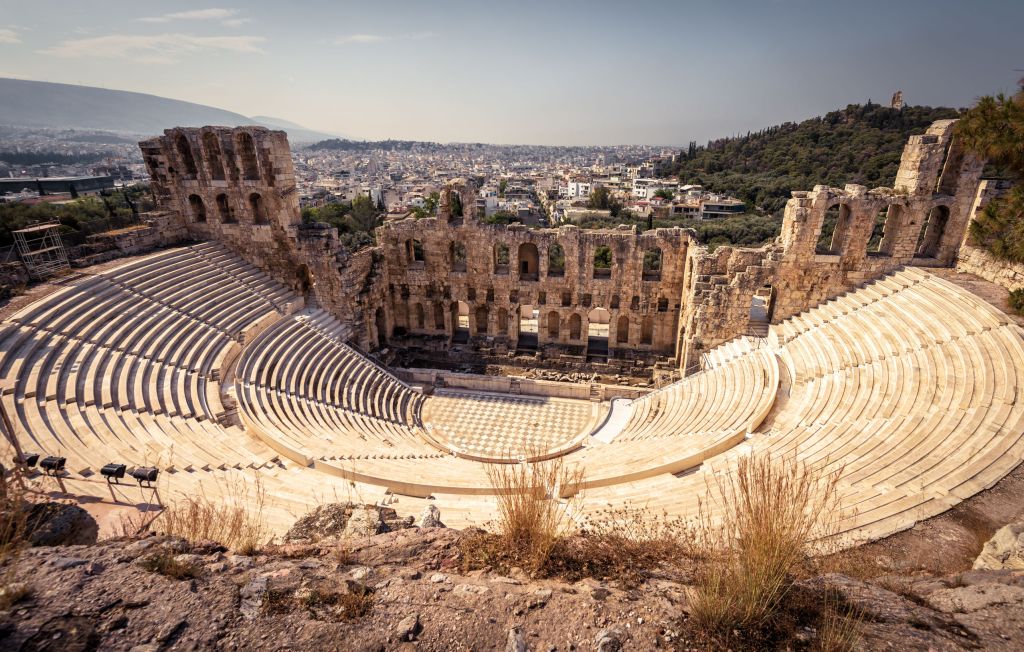
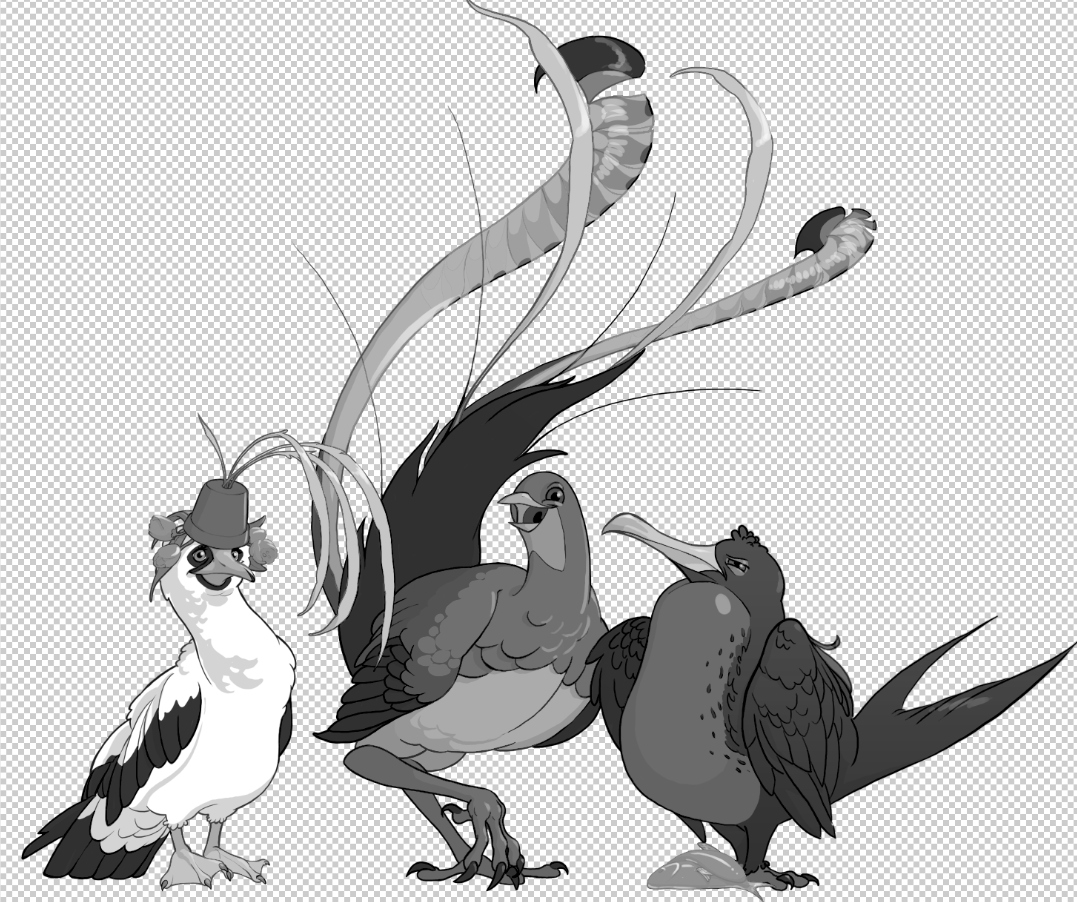
The story is narrated by an trio of avian ‘fact checkers’ in a contemporary spoof of the classic Greek chorus of ancient theatre plays that incorporates our growing awareness of ‘fake news’. And musical trailers promoting The Great Brassmonkey Bay Jewel Robbery include songs written in different popular musical genres, including jazz, rock, hip hop, country, etc.
Discovery is critical to much youth entertainment, including many games. Brio’s creative team is considering developing spin-off video games based on the book’s characters. The opportunities for young readers to learn while enjoying themselves are abundantly available to resourceful developers. Not only that, educational games are also increasingly profitable, worth $1.5 billion and growing fast, according to a 2013 US study.
After all, learning while having a good time is how most of us got our most enduring education and skills, no?
Panoramic view of the Odeon of Herodes Atticus at the Acropolis of Athens, Greece.
Are ancient literary classics still relevant at a time when some fiction works are being written on smart phones? Should young readers and writers continue to study the structure, characters, and plot of narratives written centuries ago? If so, why?
British Literary Agent Julian Friedmann thinks we should. His recent Ted Talk ‘The Mystery of Storytelling’ distills his (…well, and Aristotle’s!) ideas about what makes a successful theatrical script into a few memorable messages. He argues these are as relevant now as they were when Aristotle lived and wrote (384-322 BCE).
According to Aristotle’s trinity of essential qualities, to be successful and satisfying to audiences, a theatrical performance has to evoke pity for the hero, fear of the escalating threats he or she faces, and finally catharsis when the threat is resolved.
Blockbuster novels and films have the same demands. The structure of The Great Brassmonkey Bay Jewel Robbery, an adventure story for young readers, was based on a script structure that adheres to this formula. The twin heroes, Pax and Pip, are separated for the first time in their lives when Pip is involved in an accident at the Zoo where the twins work. When she fails to recover as expected, the twins and their family are terrified that all their dreams for the future will collapse. Pax fears he will have to face life’s great challenges alone.
The story is successful if we care enough about Pip and Pax to pity them and fear they may not be able to transcend their challenges. I won’t reveal the resolution as it risks spoiling any potential catharsis, but Friedmann’s talk is a fascinating and worthwhile reminder of why Greek tragedies have always seemed timeless to me despite centuries of change.
It also reminded me that I even included in the story a trio of avian narrators modelled on the Greek Chorus in the story! I modernized their role into fact-checkers. The job of a Greek chorus was to describe and comment on the action in a play, often through dance and song. Fact-checkers try to make audiences believe narratives are true.
Click on at link below for Friedmann’s concise insights into why writers write, what works, how British films differ from American ones, and why the best-performing theatrical stories are visual and, regardless of culture (or the sneers of critics), generally sentimental. I hope you enjoy it as much as I did: ‘The mystery of storytelling’ : Julian Friedmann at TEDxEaling – YouTube https://youtu.be/al3-Kl4BDUQ
On the subject of structure, a future blog post will review the use of nested narratives. The technique not only applies but also multiplies Aristotle’s formula, repeating and reflecting the emotional journeys of the characters for the audience like a walk through a house of mirrors.
I started writing a book that became The Great Brassmonkey Bay Jewel Robbery in 2007. When it was published in 2020, I dedicated it to my brother, Ken, and to young readers who had a tough year in 2019-2020, whom many called the Lockdown Generation. This is part of the story of why I wrote the book and dedicated it as I did.
When I left full-time employment after twenty years with Australia’s multidisciplinary scientific research organization, CSIRO, my mortgage was paid off and a modest income secured with training consultancies. I was free for the first time in my life to fulfill my dream of being a writer. But what should I write, I wondered? There were so many stories I had wanted to tell for years.
After a few false starts, I decided on a youth fantasy. I knew I needed to radically change the communication skills I had practiced for 20 years. The nonfiction commercial and scientific writing I did as a science publisher and marketer had trained me to focus more on accuracy than creativity. Youth fantasy would stretch muscles unused since university creative writing classes years earlier, I thought, and such a modest hurdle would be mastered quickly.
Right off, that should tell you how little I really knew about writing fiction!
I went through some of the earliest of the 41 journals I have written since I was sixteen years old, looking for the story ideas I had with uncharacteristic prescience cached in them for just such an occasion. I found a narrative I had drafted in my 20s. It was based on one of the curiously cinematic dreams I used to have in those days, concerning a robbery so ingenious that I remember waking up snorting in laughter. While I had the rough nugget of a story, I won’t say I had a plan.
What I did have were some aspirations I wanted to address as a writer. One of these dated from a writers’ festival I attended in 1999. A YA author whose presentation I had signed up for took a question from the audience. Why did he choose to write bleak dystopic fiction for young readers? He answered frankly, “It sells.” And after a pause, “We can’t sugar coat what’s happening.” I experienced a jolt of concern at his words. He was referring to exposing very young readers to the adrenalin rush of terrifying environmental disasters largely caused and often ignored by adults. It seemed to me more a violation of hope more than provision of equipment for the future.
In that moment, I decided writers had a profound responsibility to their audiences, and none more so than when their readers are young. Providing thrills for money is one of the world’s oldest professions. It need not be irresponsible or harmful, but when the audience is young, it can easily become both.
There are moral obligations in all professions, but I had grown up with a mother who was sadly abused as a child, so I knew youthful trauma is often an enduring and painful legacy. I decided anything I wrote—if true to a worthwhile story—would be hopeful, a quest for solutions. That at least seemed a legacy one could exercise some control over. These notions were enough to start me writing.
Writing the first draft of The Great Brassmonkey Bay Jewel Robbery was great fun, a self-indulgent romp during which I set no boundaries on my characters or what they could do, feel, achieve, and impact. Or, for that matter, their species. Why not make my characters animals? After all, I was fascinated by the audacious cockatoos, cheeky possums, delightful fairy penguins, pensive water dragons and exuberant dolphins I had watched while living near beaches on two sides of the Pacific Ocean.
During those years, I had often mentally assigned many of my animal visitors personalities, imagined among them dialogue and conflicts, flirtations, and turf wars. I felt surrounded by a charismatic troupe of potential heroes. As my suburbs I lived in attracted development, however, I had also watched the numbers of my heroes decline. In my characters’ evident vulnerability, I had an urgent plot theme: their survival on a changing planet.
A family illness displaced other priorities for years, so it wasn’t until the 2020 COVID-19 pandemic with its strict lockdown conditions began robbing young people of many of their most important life experiences that I began rewriting my initial draft in earnest. I looked at the plot with different eyes. All around me were stories of my intended youthful audience, of cancelled proms and graduations, of college courses that had to be attended online, and of relationships that developed despite that most disappointing of matchmakers, ZOOM.
I was impressed by the resilience of many young people who posted often hilarious videos about how to get through long periods of isolation. At the heart of many of those posts was creative good humor and a whatever-it-takes attitude to keeping in touch with friends. Those qualities seemed essential to keeping up the spirits of the film makers. I wanted to capture those attitudes and voices in my characters and narrative that might speak to readers and their families.
So I added to my troupe of characters the teenage twins, Pip and Pax. In a future post, I’ll write about nested narratives, how and why writers might consider a plot structure that positions one hero’s journey within another.
But first, here is my first author’s reading to introduce the twin Zookeepers, Pax and Pip, to The Great Brassmonkey Bay Jewel Robbery.
Judith Lydia Mercure reads from The Great Brassmonkey Bay Jewel Robbery




 The Artful Gluffster