Just about everybody these days, judging from the proliferation of talent shows and emerging superstars on TV and social media.
But is there a downside? Chilli Koala, Leader of the Magic Island Gang, thinks there are plenty! Is it seductive? You bet!
He was a shy poet before gaining unwanted celebrity at Brassmonkey Bay Zoo. But Chilli and the Zoo’s keepers fell under the spell of spotlights and applause. In fact, Chilli was so concerned, he wrote a song about it (with the help of musician/songwriter Jon Ross) that gives us an insight into how the mastermind of THE GREAT BRASSMONKEY BAY ZOO ROBBERY feels about fame!
Or order a copy of The Great Brassmonkey Bay Jewel Robbery. It’s perfect for middle-grade readers and a musical script of the story is available to community and youth theatre groups!
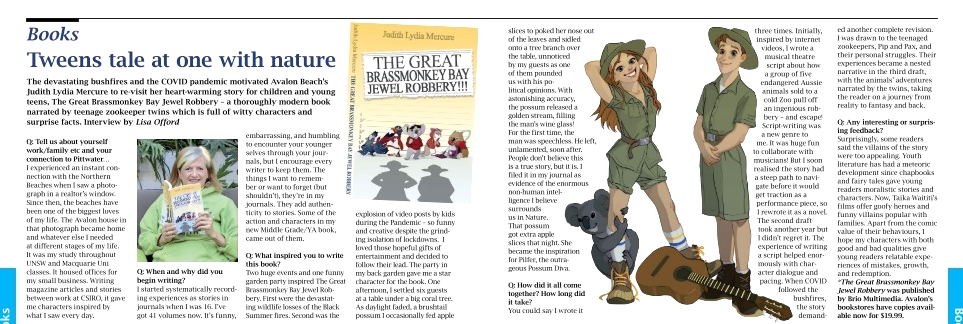
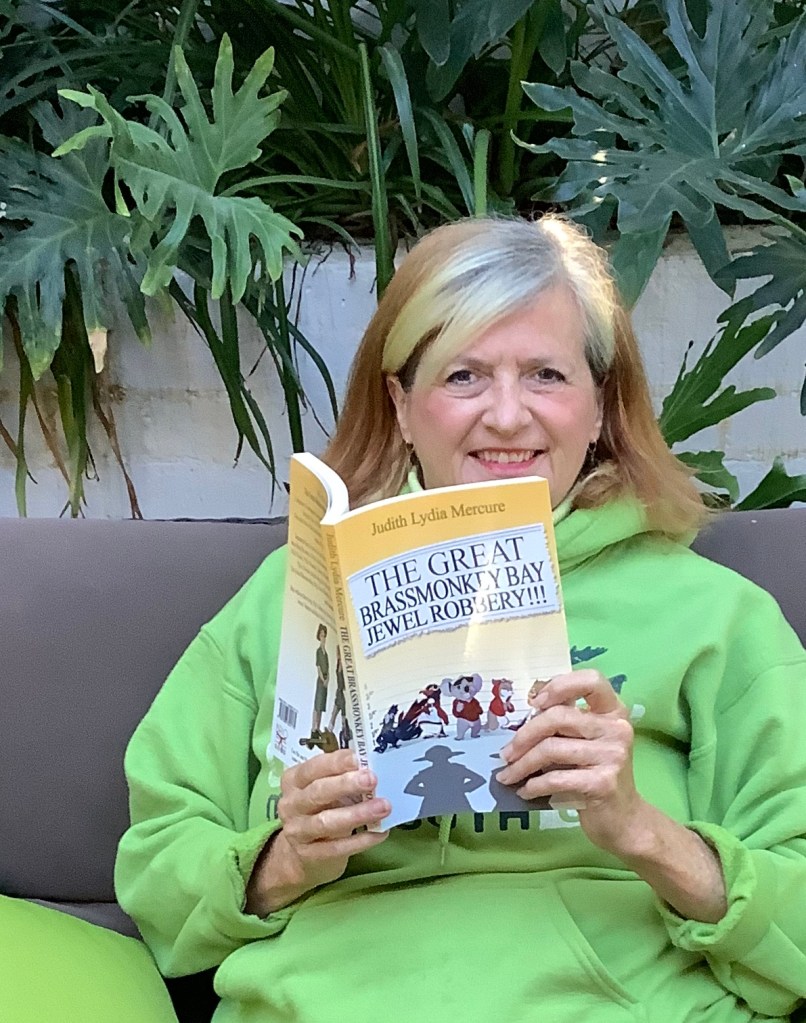
Pittwater Life Editor Lisa Offord asked Judith Lydia Mercure about what motivated her to write books for young audiences during what seems to many to be a period of relentless crisis (originally published in Pittwater Life, September 2021, pp 50-51). Local (Avalon Beach) bookstores Bookoccino and Beachside Books stock Judith Lydia’s latest book, The Great Brassmonkey Bay Jewel Robbery for A$19.99.
Lisa:Tell us about yourself work/family etc and your connection to the Northern beaches.
Judith Lydia:I experienced an instant connection with the Northern Beaches when I saw a photograph in a realtor’s window. Since then, the beaches have been one of the biggest loves of my life. That Avalon house in the photograph became home and whatever else I needed at different stages of my life. It was my study after UNSW and Macquarie Uni classes. It housed offices for my small business. Writing magazine articles and stories between work at CSIRO, it gave me characters inspired by what I saw every day.
Lisa: When and why did you begin writing?
Judith Lydia:I started systematically recording experiences as stories in journals when I was sixteen. I’ve got 41 volumes now. It’s funny, embarrassing, and humbling to encounter your younger selves through your journals, but I encourage every writer to keep them. The things I want to remember or want to forget (but shouldn’t), they’re in my journals. They add authenticity to stories. Some of the action and characters in my new Middle Grade/YA book, can be found in them.
Lisa: What inspired you to write this book?
Judith Lydia:Two huge events and one funny Garden Party inspired The Great Brassmonkey Bay Jewel Robbery. First were the devastating wildlife losses of the Black Summer fires. Second was the explosion of video posts by kids during the Pandemic—so funny and creative despite the grinding isolation of lockdowns. I loved those hopeful gifts of entertainment and decided to follow their lead.
The party in my back garden gave me a star character for the book. One afternoon, I settled six guests at a table under a big coral tree. As daylight faded, a brushtail possum I occasionally fed apple slices to poked her nose out of the leaves and sidled onto a tree branch over the table, unnoticed by my guests as one of them pounded us with his political opinions.
With astonishing accuracy, the possum released a golden stream, filling the man’s wine glass! For the first time, the man was speechless. He left, unlamented, soon after. People don’t believe this is a true story, but it is. I filed it in my journal as evidence of the enormous non-human intelligence I believe surrounds us in Nature. That possum got extra apple slices that night. She became the inspiration for Pilfer, my outrageous Possum Diva.
Lisa: How did it all come together? How long did it take?
Judith Lydia:You could say I wrote it three times.Initially, inspired by internet videos, I wrote a musical theatre script about how a group of five endangered Aussie animals sold to a cold Zoo pull off an ingenious robbery—and escape!
Script-writing was a new genre to me. It was huge fun to collaborate with musicians. But I soon realised the story had a steep path to navigate before it would get traction as a performance piece, so I rewrote it as a novel. The second draft took another year but I didn’t regret it. The experience of writing a script helped enormously with character dialogue and pacing.
When COVID followed the bushfires, the story demanded another complete revision. I was drawn to the teenaged Zookeepers, Pip and Pax, and their personal struggles. Their experiences became a nested narrative in the third draft, with the animals’ adventures narrated by the twins, taking the reader on a journey from reality to fantasy and back.
Lisa: Any interesting or surprising feedback from readers you’d like to share with us?
Judith Lydia:Surprisingly, some readers said the villains of the story were too appealing. Youth literature has had a meteoric development since chapbooks and fairy tales gave young readers moralistic stories and characters. Now, Taika Waititi’s films offer goofy heroes and funny villains popular with families. Apart from the comic value of their behaviours, I hope my characters that have both good and bad qualities give young readers relatable experiences of remorse, change, and redemption.
How do authors create engaging characters? Let’s take the animal characters in The Great Brassmonkey Bay Jewel Robbery. What shaped those characters? Like most writers, when I created Pilfer Possum, her personality was based to a significant degree on some real possums who live in my garden, my trees, and sometimes, my garage.
Called by some readers an ‘out-of-control Diva’, Pilfer Possum is a relentless source of antics in the book. Two of her adventures inspired the teaser song at the bottom of this article. But were they invented? Not entirely. I got quite a bit of inspiration. Let me give you two examples.
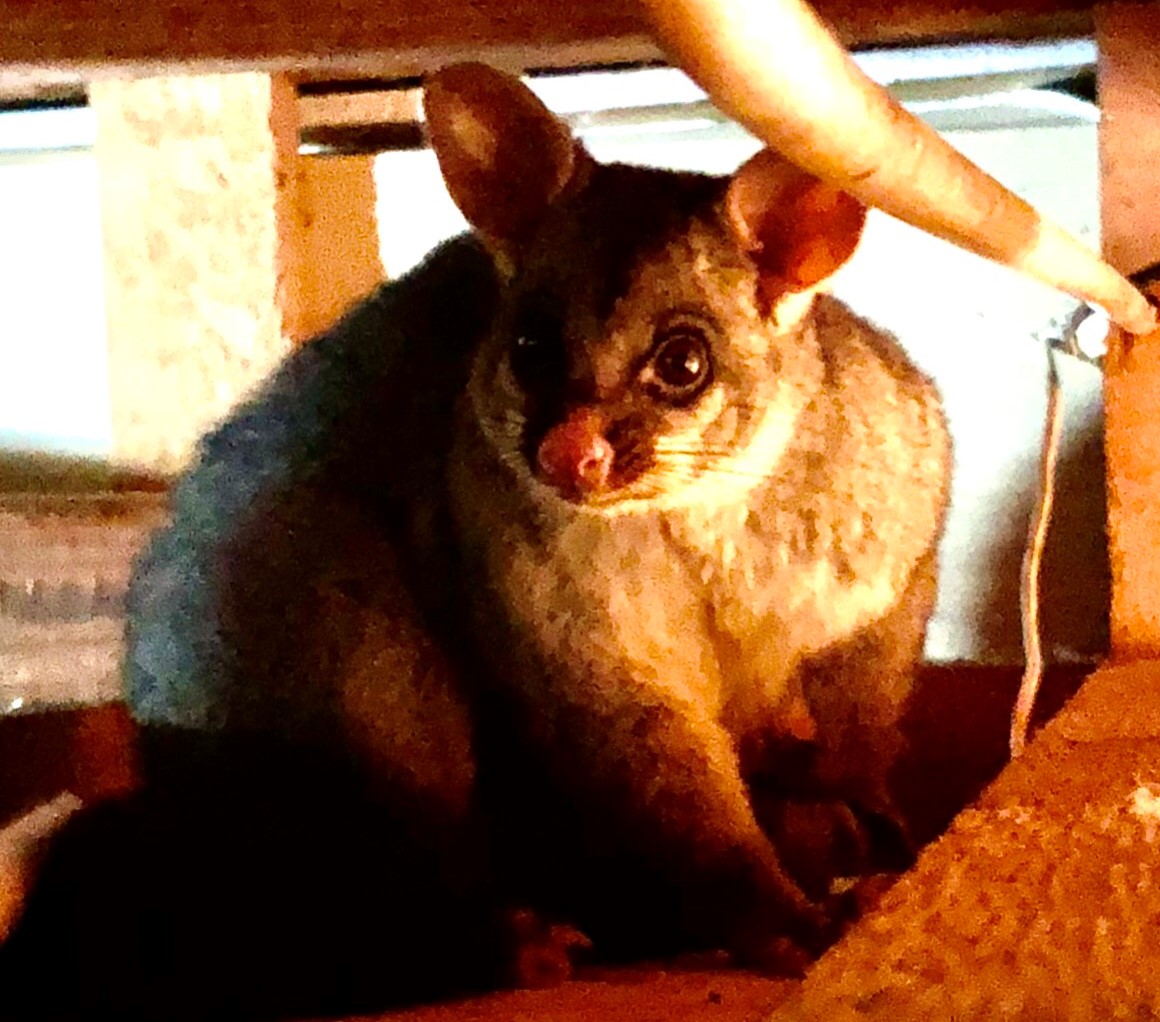
Some people think Australian Brush-tailed Possums are nuisances, but they are also irresistible. Their scientific name Trichosurus vulpecula means ‘furry tailed’ and ‘little fox’. They have big, intent eyes, and improbably pink noses. Like many critters, they have become increasingly confident in their interactions with humans. They are adaptable, but also territorial. Unlike their attitudes to cats and dogs, Brush-tails get used to people coming and going onto what they clearly believe is their turf. When you have been sound asleep and they run across the roof over your head in the middle of the night, you can’t ignore them: because it sounds like they are wearing Army boots.
One night I heard something more than the usual thrashing about on my metal roof: a resounding thump that sounded like it was coming from my living room. I blundered sleepily out of my bedroom and switched on the light. To my astonishment, an adult possum was sitting on the top of my bathroom door. We stared at each other. It took some time to consider my options, as I didn’t fancy her using me as a scaling ladder or my chasing her through the house if I scared her down from her precarious perch. Eventually I fetched a chair and a towel. She braced herself for a scramble down my back to the floor but was successfully wrapped up (which, fortunately, makes them go quiet) and released into the garden. She bolted into the darkness.
But how on earth did she get into the living room, I wondered. There were no open doors or windows. I abandoned the mystery and went back to bed. The next morning, I looked around. I finally stopped in front of my gas fireplace. It has a glass front and sides. On the inside, which I rarely cleared of dust and soot, I noticed two sets of parallel ribbon-like streaks.
The clues were irrefutable: the possum must have crept from the roof into the chimney, looking for shelter. She had slipped, making a desperate effort to cling to the interior of the chimney as she fell. The streaks were made by the soft pads on her paws as she made a futile effort to grip the smooth surface of the glass. Why she chose to claw her way up a wooden bathroom door and perch on the top, I’ll never know. I suspect the door may have been the first object she encountered that promised an escape route back to the roof.
To be honest, I had always found Brush-tail Possums endearing. On days when I’d be working in my office, I’d sometimes spot movement from my window. I knew the culprit would be crouching among the branches of a big paperbark tree. I’d pause my work and bring out an offering. A possum would creep closer down the tree at my approach. She would find a spot in the notch of the tree at about my head height and reach out to accept my slice of apple or carrot.
After a while, we became pretty comfortable with each other. Sometimes possums would show themselves when I had guests too. I guess they figured more people might mean more handouts.
One afternoon, I hosted a dinner party outdoors. The couple I had invited to dinner called shortly before they were to arrive to say they were getting unexpected visitors, family from overseas, should they cancel? I told them not to change their plans. I had plenty of food. Why not bring their relatives?
What I didn’t count on was that one of my friends’ in-laws was self-absorbed and excessively talkative. He had recently acquired a new job he clearly thought was pretty stellar and wanted to talk about it. It didn’t take me long to regret my hospitality. I guessed we were in for a long evening.
Bored into silence by an endless monologue, I cast about for a distraction as my guests helped themselves to the plates of food on the table. A movement above my head caught my eye. One of my possums poked her head out from a cluster of leaves on a branch above us. Her eyes were glittering with some emotion, probably greed. For the first time I realized that I hadn’t taken into account that the position of our table was near, indeed under, my possums’ favorite tree.
When the speaker reached a point in his story that he found particularly riveting, he raised his voice. I didn’t feel I could interrupt him to point out the possum to my guests. In the fading light, I appeared to be the only person at the table who had seen a full-sized brush-tail possum edge out onto a branch that overhung the table.
The possum was creeping along the branch perhaps three meters above our heads. When the animated brother-in-law grinned at his audience with what he seemed sure was shared delight, the possum paused, but still, no one noticed her. The speaker continued waving his arms in the excitement of his tale about people I didn’t know–and at that moment was convinced I wouldn’t wish to.
In the light of the candles on the table, the possum’s eyes eyes shone like obsidian. I saw her swish her tail from side to side. She edged further down the branch and turned quietly, her back to me now. She lifted her tail.
Suddenly, a golden stream of liquid hissed as it descended from the branch. Not a drop splashed onto the tablecloth as the near-empty wine glass of the speaker was miraculously filled.
I stifled a hoot of admiration.
For the first time since his arrival, my unwelcome guest was silent as a stone. He stared at his now-brimming wine glass. The moment turned into a freeze-frame tableau of five people, four who were speechless with horror, and one–I admit–with glee. I watched the possum sidle back across the branch toward the safety of the broad tree trunk.
Although quips ran through my mind like a rat pursued by a terrier, I settled for a syrupy smile. “Would anyone care for another glass of wine?” I asked. I expect no one mistook my tone for sincerity.
My guests shook their heads. They hastily made excuses and packed up to leave.
Once they had all decamped, I cleared the table –but not without bringing with me some slices of apple.
My possum was watching contentedly from her tree. The evening, our evening, she seemed to be thinking, had been saved. She took her reward from my fingers. I left her to spend the rest of the evening with a book and a glass of wine–one fresh from a bottle safely chilling in the fridge.
Those stories not only informed Pilfer’s character but also became the lyrics of a song about her stowing away on a yacht bound for Brassmonkey Bay. There is quite a bit of detail in this story, not all of which is needed to move the plot along, but it establishes the characters’ personalities.
I hope you enjoy the version of Pilfer’s antics in ‘Stowaway’s Stomp’ BTW, we used music and guest readers to introduce characters in some of the book’s marketing for a couple of reasons. First, because most book trailers are dominated by the author’s talking head, and we wanted something different and memorable, that could also be applied to later books in the series. Second, several readers asked whether a performance script based on the book might be in the works. When I imagined the story’s action on a stage, I could only imagine it performed by a youth theatre group, and I wanted to introduce songs kids could sing. The lyrics to this song were written by me, but the music was composed and sung by Nashville musician, Jon Ross. He tries our songs out on his own kids. They are hardened critics. If the songs don’t pass muster with them, they don’t pass!
We will explore different marketing tactics under the ‘Getting Noticed’ page, so stay tuned and in touch!
I started writing a book that became The Great Brassmonkey Bay Jewel Robbery in 2007. When it was published in 2020, I dedicated it to my brother, Ken, and to young readers who had a tough year in 2019-2020, whom many called the Lockdown Generation. This is part of the story of why I wrote the book and dedicated it as I did.
When I left full-time employment after twenty years with Australia’s multidisciplinary scientific research organization, CSIRO, my mortgage was paid off and a modest income secured with training consultancies. I was free for the first time in my life to fulfill my dream of being a writer. But what should I write, I wondered? There were so many stories I had wanted to tell for years.
After a few false starts, I decided on a youth fantasy. I knew I needed to radically change the communication skills I had practiced for 20 years. The nonfiction commercial and scientific writing I did as a science publisher and marketer had trained me to focus more on accuracy than creativity. Youth fantasy would stretch muscles unused since university creative writing classes years earlier, I thought, and such a modest hurdle would be mastered quickly.
Right off, that should tell you how little I really knew about writing fiction!
I went through some of the earliest of the 41 journals I have written since I was sixteen years old, looking for the story ideas I had with uncharacteristic prescience cached in them for just such an occasion. I found a narrative I had drafted in my 20s. It was based on one of the curiously cinematic dreams I used to have in those days, concerning a robbery so ingenious that I remember waking up snorting in laughter. While I had the rough nugget of a story, I won’t say I had a plan.
What I did have were some aspirations I wanted to address as a writer. One of these dated from a writers’ festival I attended in 1999. A YA author whose presentation I had signed up for took a question from the audience. Why did he choose to write bleak dystopic fiction for young readers? He answered frankly, “It sells.” And after a pause, “We can’t sugar coat what’s happening.” I experienced a jolt of concern at his words. He was referring to exposing very young readers to the adrenalin rush of terrifying environmental disasters largely caused and often ignored by adults. It seemed to me more a violation of hope more than provision of equipment for the future.
In that moment, I decided writers had a profound responsibility to their audiences, and none more so than when their readers are young. Providing thrills for money is one of the world’s oldest professions. It need not be irresponsible or harmful, but when the audience is young, it can easily become both.
There are moral obligations in all professions, but I had grown up with a mother who was sadly abused as a child, so I knew youthful trauma is often an enduring and painful legacy. I decided anything I wrote—if true to a worthwhile story—would be hopeful, a quest for solutions. That at least seemed a legacy one could exercise some control over. These notions were enough to start me writing.
Writing the first draft of The Great Brassmonkey Bay Jewel Robbery was great fun, a self-indulgent romp during which I set no boundaries on my characters or what they could do, feel, achieve, and impact. Or, for that matter, their species. Why not make my characters animals? After all, I was fascinated by the audacious cockatoos, cheeky possums, delightful fairy penguins, pensive water dragons and exuberant dolphins I had watched while living near beaches on two sides of the Pacific Ocean.
During those years, I had often mentally assigned many of my animal visitors personalities, imagined among them dialogue and conflicts, flirtations, and turf wars. I felt surrounded by a charismatic troupe of potential heroes. As my suburbs I lived in attracted development, however, I had also watched the numbers of my heroes decline. In my characters’ evident vulnerability, I had an urgent plot theme: their survival on a changing planet.
A family illness displaced other priorities for years, so it wasn’t until the 2020 COVID-19 pandemic with its strict lockdown conditions began robbing young people of many of their most important life experiences that I began rewriting my initial draft in earnest. I looked at the plot with different eyes. All around me were stories of my intended youthful audience, of cancelled proms and graduations, of college courses that had to be attended online, and of relationships that developed despite that most disappointing of matchmakers, ZOOM.
I was impressed by the resilience of many young people who posted often hilarious videos about how to get through long periods of isolation. At the heart of many of those posts was creative good humor and a whatever-it-takes attitude to keeping in touch with friends. Those qualities seemed essential to keeping up the spirits of the film makers. I wanted to capture those attitudes and voices in my characters and narrative that might speak to readers and their families.
So I added to my troupe of characters the teenage twins, Pip and Pax. In a future post, I’ll write about nested narratives, how and why writers might consider a plot structure that positions one hero’s journey within another.
But first, here is my first author’s reading to introduce the twin Zookeepers, Pax and Pip, to The Great Brassmonkey Bay Jewel Robbery.
Judith Lydia Mercure reads from The Great Brassmonkey Bay Jewel Robbery
Book launches during a Pandemic certainly pose challenges. No one wants to put readers and bookstore staff and customers at risk by organizing face-to-face readings and talks. But there are other opportunities for readers to talk with authors whose work interests them.
We are all familiar with book trailers and reviews as means of getting information about books, but many readers are also interested in hearing the author read from and describe the creative journey that resulted in their books. With more book clubs meeting by Zoom and other conferencing systems these days, growing numbers of authors are happy to drop in to meetings for discussions and readings by Zoom, regardless of where the audience may be. Short video readings from my own latest book, The Great Brassmonkey Bay Jewel Robbery, both by me and by invited guest readers, have been posted as teasers on Youtube and shared on this eqine as well as on the author and character websites. I have also joined meetings and participated in interviews by Zoom, and while those are different experiences from face-to-face meetings, a big advantage is that I can go almost anywhere, almost any time. For more information about Zoom visits and readings, email jlm@judithlydiamercure.com for details.
The Great Brassmonkey Bay Jewel Robbery is now available from bookstores and online retail providers everywhere. In addition, the publisher, Brio Multimedia, is offering the book through regional booksellers to avoid exchange rate fluctuations and delivery costs and delays. Check http://www.judithlydiamercure.com for updates.

 The Artful Gluffster