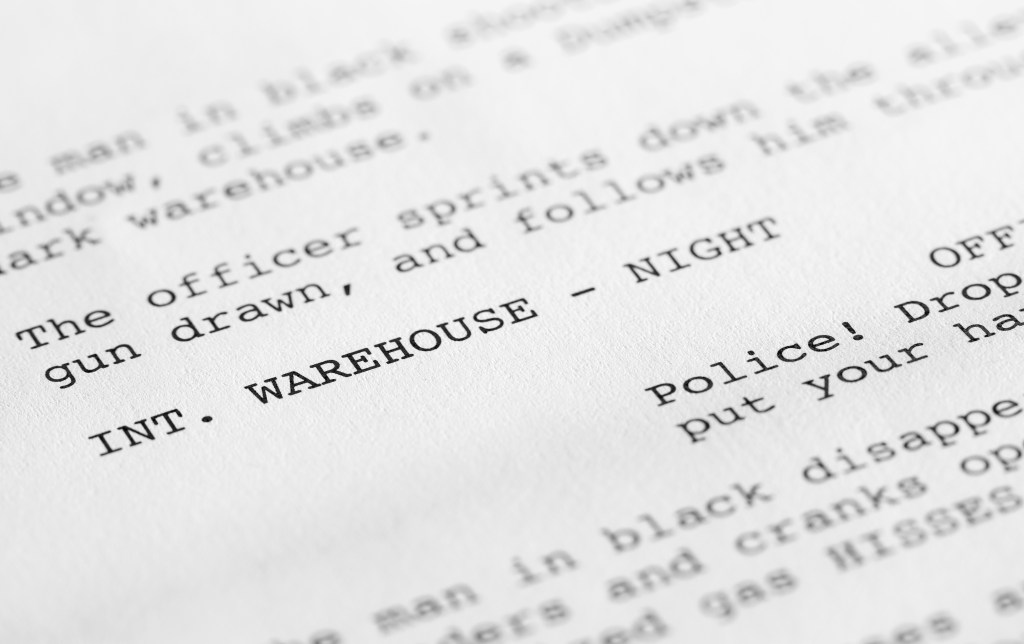
Many films begin as books. Relatively few books begin as films. But there are benefits of and good reasons for writing your book first as a script, and then writing a novel based on your script, instead of the other way around.
Admittedly, the art forms are very different. Scriptwriters have different expectations from novelists. Words hardly matter in the early stages of a film’s development. In fact, visual storyboards are common early drafts. Action, characters’ development, and the outcomes are considerations that help writers structure good scripts. Films live or die on structure, plot pace, and the quality of their cinematography. Often, if a production is seriously considered, scriptwriters will be changed between drafts. A script is hardly ever your baby.
By contrast, a novel is always your baby, and you can smother it with love. Novelists love words. They love the freedom a novel gives them to move between time, setting, voice, mood, gender. Unconstrained by the limitations of a stage or a screen, novelists have the freedom to emphasize sensory effects other than the visual in their writing. Novelists can write thousands of pages. Scriptwriters? They can’t.
But here are a few reasons I have found it worth the work of starting a literary creation with a script, an approach I used with The Great Brassmonkey Bay Jewel Robbery.
First, it is commonly observed that many novelists could cut (part or all of) their first chapter and it would improve their story. So writing the first draft of a work as a script disciplines the writer to focus on the story and its essential message within a framework: one page a minute for a 2-hour film, for example.
Second, the pace of your story will be tighter and more active. As mentioned above, the art of structuring a movie is very different from that of a book. Scriptwriters often start by sketching a series of scenes briefly, often on note cards, and ordering them on a table or desk, to get a sense of the visual flow of the work. Scripts move from action moment to action moment. If you start writing a new work with a script, you’ll be less likely lose the readers attention by spending too much time setting the mood and describing the background. Making love to your words is about you showing what you can do. Scenes and images are about viewers.
Third, your dialogue will be more effective and convincing. Writers are constantly warned to ‘show, don’t tell’ their characters’ personalities and actions. If you write an exchange of banter in your first draft script, your characters will show your readers how witty, mean, or funny they are. Scripts also expose gaps we can miss in novels. Table reading a script with friends is a great way to pick up on dialogue dissonance and discover new plot directions.
Fourth, if done consistently, the ‘voice’ you create for your characters will differentiate them, create tension or attractions between them, and help drive the plot.
Fifth, dialogue-driven action and characters is more respectful to your readers. Readers like to make up their own minds about characters, their motivations, and their choices. They don’t like to be told what to think about them.
Sixth, the novel may help sell your film. Most novelists dream of getting a film option on their book–so much so that many works are written to optimize that possibility. It can take a few years to write and a year or more to publish a book but it often takes decades to produce a film. Producing a films costs millions, so investors are less likely to back a script, no matter how good, written by an unknown. Best-selling books are far less costly to publish and market and often sell film scripts by producing hard evidence of success with audiences.
Finally, if you think you might want to create a film or play, rewriting a script from the novel is much easier than writing a script from scratch. The hard work has been done, sales results of the book tell you whether it’s worth the effort of finding and convincing financial backers, and the second draft of a script will be more nuanced and effective.
Rewriting a book is really hard work. Creating a draft as a script can make the action come alive for the author as well as future readers!
 The Artful Gluffster